What A 1990s Summerlin Home's Roof And A/C Will Cost Its Next Buyer
November 19, 2026
November 19, 2026
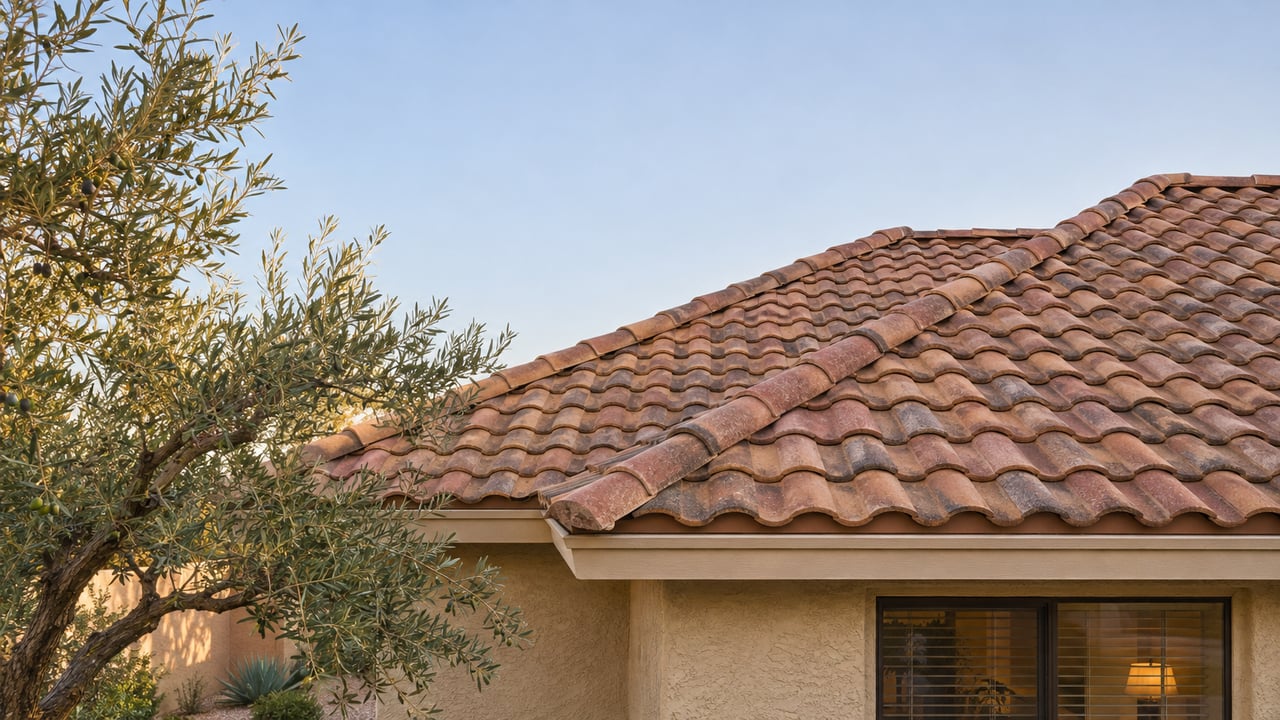
A house in The Trails can look exactly as it did on move-in day. The concrete tile is intact and the stucco is clean, and the street still runs toward the Trails Village Center, which opened in 1998. Underneath the tile, the material that keeps water out of the attic has been aging since the first owners got their keys. In this part of Summerlin, a buyer can count on paying for that material and for the air conditioner. What the buyer can still decide is whether that cost comes out of their own savings after closing or gets settled in the offer, and this fall's numbers favor the offer.
Summerlin's own history page marks the order in which the community was built. Development started in The Hills in 1990, the same year The Hills Park opened, and the first family moved into The Hills in March 1991. The Hills South followed in 1991, built around Eagle Hills, Tournament Hills and TPC Summerlin. The Pueblo began in 1992, with its Pueblo-style architecture, The Pueblo Park and The Pueblo shopping center. The Trails began in 1993 and includes The Trails Community Center, The Trails Park and The Trails Paseo Park. The Arbors followed in 1996 with Arbors Paseo Park, Tree Top Park and Cottonwood Canyon, and The Willows came in 1997 with The Willows Community Center, The Willows Park and Spotted Leaf Park.
By late November 2026, that means development in The Hills began 36 years ago and development in The Willows began 29 years ago. Each house has its own construction date, and a village's start year sets only the earliest a home there could have been built. For the earliest streets, though, the arithmetic is simple. Any component with a 15- to 30-year life in desert heat has already been replaced at least once, or it is overdue.
Mature parks and off-street trails that already connect the villages are a big part of why buyers look at these villages. Summerlin describes its village trails as off-street routes, often running through arroyos, that link parks and other destinations. The same 30 years that grew those parks have worn out the parts of the house a listing photo doesn't show.
In Southern Nevada, concrete tile roofs can last around 50 years, according to cost figures the Las Vegas Review-Journal published on October 26, 2026. The same report says the underlayment beneath the tile typically wears out sooner. It relays a roofing consultant's reserve-study estimate of about 15 to 20 years in desert heat, against roughly 25 years elsewhere. Local roofers and inspectors use a somewhat longer range of 20 to 30 years. Either way, a home built in 1993 is past its first underlayment window.
That puts the useful question on the roof's history, because a roof's appearance says little. From the street, a 1993 roof that was redone in 2015 looks the same as one that has never been touched. The Review-Journal describes how the work is done. In a "raise and reset," roofers lift the tiles, install new underlayment and flashing around the pipes, and put the existing tiles back when they can be reused. Mike Pullen of Cooper Roofing and Solar told the paper this can save homeowners a substantial amount of money.
Local estimates published in fall 2026 put that underlayment job at roughly $12,000 to $25,000 for a typical 1,800-square-foot home, and a larger house costs more. Home Cost Lens, the cost-tracking firm quoted in the same Review-Journal article, puts a full concrete or clay tile roof at about $24,050 on its modeled basis.
Local estimates from fall 2026 give a Las Vegas A/C system a working life of about 10 to 15 years and put a full replacement at $8,000 to $14,000. That is a shorter life than the roof underlayment's, and a home built in 1997 has likely gone through two systems by now and may be close to its third.
For the A/C, the install date printed on the unit matters more than the year the house was built. A 2014 system in a 1991 house in The Hills South is close to the end of its range, and a 2022 system in the house next door is not. An inspection report gives a buyer that date, and in this market the date is worth roughly $8,000 to $14,000 either way.
Plumbing deserves one short check on the oldest streets. Polybutylene supply pipe went into many Las Vegas homes built from about 1978 to 1995. Active Plumbing, a local firm, rates Summerlin as low risk, with only a small number of the earliest 1991 to 1993 homes likely to have it. When it does turn up, local plumbers estimate a whole-house repipe at roughly $4,500 to $15,000 for a typical 1,500- to 2,500-square-foot home. The same firm says buyers commonly ask for a credit, a price reduction or a seller-paid repipe when an inspector flags it.
Las Vegas REALTORS data for October 2026, reported by the Review-Journal on November 6, put the Southern Nevada single-family median at about $475,000, up 0.1% from October 2025. At the end of October, 8,112 single-family homes were listed without offers, 7.6% more than a year earlier. At October's sales pace, that is nearly six months of supply, compared with just over 4.5 months a year earlier.
Sellers have been responding. In August 2026, 66.7% of Las Vegas home sales included seller concessions, the fourth-highest share among U.S. metros, according to a Redfin report covered by the Review-Journal on October 12. The national share that month was 44.7%. The same article reported that mortgage rates rose above 7% in late September and that concessions commonly take the form of seller-paid closing costs or mortgage-rate buydowns.
The concession data is valley-wide, and it covers rate buydowns as well as repair credits. Its importance for a 1990s Summerlin home is narrower. When about two of every three sales close with something from the seller, a buyer who asks for money toward a known cost is making the most common request in this market. An underlayment estimate and an A/C install date give that request a specific number.
Here is how the local fall 2026 estimates add up for a house from Summerlin's first decade that still has its original underlayment, an A/C near the end of its life and, on the oldest streets, polybutylene pipe.
| Item | Local estimate | What sets the number |
|---|---|---|
| Tile underlayment, raise and reset | About $12,000 to $25,000 for about 1,800 sq ft | Square footage, and how many tiles can be reused |
| Full tile roof, modeled | About $24,050 | Home Cost Lens figure, October 2026 |
| A/C system replacement | About $8,000 to $14,000 | The unit's install date |
| Whole-house repipe | About $4,500 to $15,000 | Applies only if polybutylene is found |
The underlayment and the A/C alone come to about $20,000 to $39,000. With a repipe, the range is about $24,500 to $54,000. Against the valley's $475,000 October median, the narrower range is roughly 4% to 8% of a median-priced house, and the wider one roughly 5% to 11%. The same work on a larger house costs more.
Each of those line items is cheaper to settle before closing than after. A seller with six months of competing inventory has a reason to agree to a credit. A buyer who discovers the same roof in year two of ownership has nobody left to ask.
Our comparison of new construction and resale in Summerlin covers the wider tradeoff. For a buyer who has already chosen the older villages for their parks and trails, the useful step is to price the roof and the A/C at the offer, the same way a buyer would weigh a special assessment before committing to a house.
If a 1990s Summerlin home's roof has never leaked, does the underlayment still matter? Yes. The tile carries no information about the layer under it, and that layer has a desert-heat life of roughly 15 to 30 years depending on the estimate. A record of earlier roof work is the best evidence of where the current underlayment stands.
Which villages does this apply to? The homes most affected are in Summerlin's first decade of villages: The Hills, The Hills South, The Pueblo, The Trails, The Arbors and The Willows, where development began between 1990 and 1997. A particular home's construction year and its repair records matter more than the year its village began.
Is this fall's concession rate specific to Summerlin? No. The 66.7% figure covers Las Vegas metro sales in August 2026. It describes the overall market that Summerlin sellers are competing in.
These cost figures are general information drawn from local estimates published in fall 2026. They are not legal, tax or financial advice, so please confirm your own numbers with a licensed contractor, inspector or lender before relying on them.
If you're considering a home in one of Summerlin's original villages, The Grauberger Team can help you build the roof and A/C history into your offer before you sign. If you own one of these homes and plan to sell, request a home valuation so your price reflects what has already been replaced.
We look forward to helping you find the home of your dreams. Please don't hesitate to call or email us today.