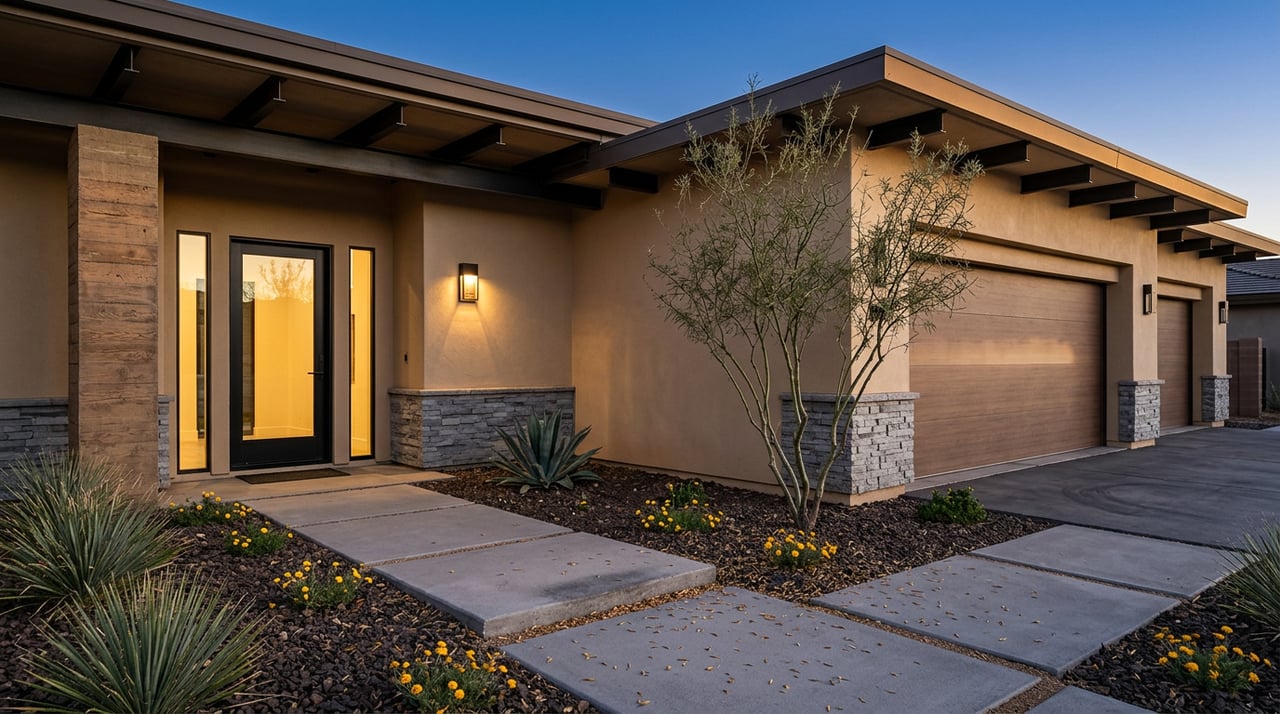
Why Two Summerlin Homes At The Same Price Can Cost $3,600 A Year Apart
September 24, 2026
September 24, 2026
The surprise rarely shows up at the closing table. It shows up in November, on the first full property tax bill, as a line item that was never discussed during the showing, the inspection, or the loan approval. It is not the HOA. It is not a late fee. It is a Special Improvement District assessment, and depending on which Summerlin village a buyer chose, that line can run from a rounding error to a genuine monthly obligation that lasts another decade or two.
Buyers comparing two Summerlin listings at the same price tend to compare square footage, lot size, and finish level. Those matter. But the number that actually separates a $700,000 home in one village from a $700,000 home in another is often invisible on the listing sheet: which decade's infrastructure bond is still attached to the parcel, and how the community's layered HOA structure stacks on top of it.
Summerlin was not built in one phase. It has grown in stages since 1990 across roughly 26 distinct villages, and it now operates under three separate council areas: Summerlin North, Summerlin South, and Summerlin West. Each village inside those councils was financed on its own timeline, which means the community everyone refers to as "Summerlin" is really a patchwork of different infrastructure bonds at very different stages of payoff.
That matters because the financing tool the master plan used to build roads, sewer lines, drainage, and streetlights before homes ever sat on the land was a Special Improvement District, or SID. Villages built decades ago, like The Trails and The Pueblo, generally have those original bonds paid down to zero at this point. Villages still being built out on the western edge of the master plan, including Stonebridge and Redpoint Square, are often still amortizing an active assessment. Two homes a few miles apart, both listed at a similar price, can be sitting on completely different financial timelines without either seller mentioning it.
A Special Improvement District is authorized under Nevada Revised Statutes Chapter 271. The mechanism is straightforward: before a developer can sell finished lots, the roads, sewer, water, and lighting have to exist. Rather than build that infrastructure entirely with private capital and fold the cost into the sticker price, Summerlin has used bond-funded districts, and the county assesses each parcel a share of the repayment. The Clark County Treasurer's office describes it plainly: the assessment is a lien on the property, billed separately from the standard property tax bill, and apportioned according to the benefit each parcel received from the improvement.
The assessment is billed semi-annually, alongside the regular tax cycle, and it runs with the land. That last part is the one buyers most often miss. When a home sells, the remaining SID balance does not reset or disappear. It transfers to the new owner unless someone pays it off at closing. A buyer who assumes a home with eight years left on its bond is agreeing to eight more years of semi-annual payments, whether or not that was clearly spelled out during negotiations.
Summerlin's own assessment documentation, which directs owners to a third-party bond administrator for payoff schedules, shows that prepayment is allowed but comes with a penalty that declines over the life of the bond, starting as high as 3% and stepping down toward zero as the bond matures. So paying off early is possible. It is just not free, and the math only works in certain windows.
Here is where the comparison gets concrete. Summerlin operates a tiered association structure: a master Summerlin Council fee, plus a village-level sub-association, plus in many cases a SID line, all stacked on the same monthly bill.
| Cost layer | Older, paid-off-SID village (example: The Trails, The Pueblo) | Newer, active-SID village (example: Stonebridge, Redpoint Square) |
|---|---|---|
| Summerlin Council master fee | Included in council area dues | Included in council area dues, roughly $69/month in Summerlin West, of which about $37 funds parks, trails, and recreational programming valley-wide |
| Village sub-association | Roughly $40 to $100/month for standard, non-gated neighborhoods | Similar range, often higher where amenities are newer |
| Gate premium, if applicable | $80 to $150/month added for key-fob or code access | Same range, sometimes more for guard-gated entries |
| SID assessment | Paid off; no line item | Active, commonly $1,300 to $2,800 a year in Summerlin West's newer sections, based on the original bond size and how much principal remains |
Add it up and the difference between two otherwise comparable $700,000 homes can land around $300 a month, which works out to roughly $3,600 a year, purely from where the home sits in Summerlin's financing history. That gap has nothing to do with condition, upgrades, or negotiating skill. It is baked into the parcel before either party sits down to talk price.
A stat worth holding onto if it changes how you read builder pricing: valley-wide, 2026 SID and LID assessments across master-planned communities generally range from about $300 to $3,200 a year depending on how recent the bond issuance was and how large the original infrastructure package needed to be. Summerlin's newest sections sit toward the middle of that range, not the extreme, but the middle is still real money over a 15 to 20 year term.
Because the districts are parcel-specific, not neighborhood-wide, the only reliable way to know what a given home carries is to check the actual parcel, not assume based on the village name. Before making an offer in any Summerlin community, it is worth confirming:
Title officers and escrow companies that work regularly in Summerlin typically pull this as part of a standard search, but it is reasonable to ask the question directly rather than wait for it to surface in the settlement statement.
On the seller side, an active SID balance becomes a real point of leverage. A seller with a low remaining balance can often pay it off from proceeds and use a clean, assessment-free listing as a selling point against a comparable home nearby that still carries payments. A seller with a large balance may prefer to let it transfer and price the home accordingly.
It is worth being clear that paying off a SID early is not the same as a kitchen remodel. It does not add resale value dollar for dollar, because it is debt repayment, not a capital improvement. What it does change is the buyer's monthly qualifying number and their debt-to-income ratio, which in a market where borrowing costs matter, is not a small thing.
That market context is worth naming directly. Mortgage rates moved back above 7% in mid-September 2026, according to Mortgage News Daily's daily index, reversing an extended stretch below that threshold. At the same time, active inventory across the Las Vegas Valley climbed to roughly 8,100 single-family homes with months of supply near 4.7, giving buyers more room to negotiate than they had a year or two earlier. In that environment, asking a seller to address a SID balance, rather than simply accepting the assumption, is a reasonable and increasingly common ask.
Does paying off a SID increase my home's resale value? Not directly. It removes a recurring lien and a monthly obligation, which can make a listing more attractive next to a comparable home that still carries a balance, but it is not treated like a renovation that adds equity.
Is every home in Summerlin West carrying an active SID? No. Balances are parcel-specific. Some sections are further along in their bond term than others, and the only reliable answer comes from checking the individual parcel rather than assuming based on the village.
Are SID assessments the same as HOA dues? No. HOA dues are private fees that fund community amenities and continue indefinitely. A SID is a public bond repayment with a defined end date, collected separately, usually alongside the property tax bill.
Can I still negotiate who pays the SID after I've made an offer? It is far easier to raise before the purchase agreement is signed. Once terms are set, changing who pays the balance typically requires an amendment both parties agree to.
If you are comparing homes across Summerlin's villages and want the real carrying cost, not just the list price, laid out clearly before you write an offer, the Grauberger Team can walk you through the specific parcel, its assessment history, and what it actually means for your monthly number. Request a Home Valuation to start that conversation.



We look forward to helping you find the home of your dreams. Please don't hesitate to call or email us today.